 AuroraWatch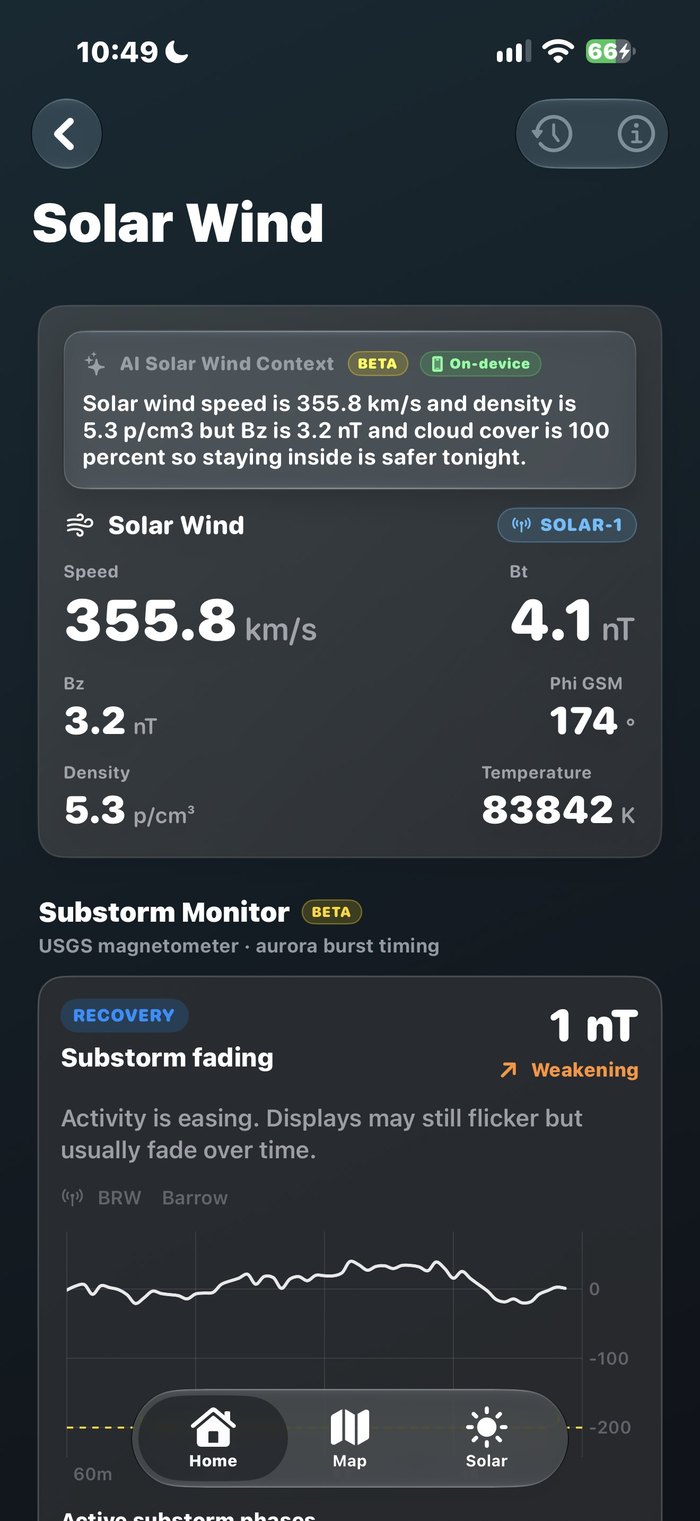
The Sun has had its busiest week in a while, and several clouds of solar material are now on their way to Earth. If the timing works out, the next couple of nights could bring aurora to both hemispheres.
What happened on the Sun this week
Most of the action has come from one sunspot group, active region 4549. It has a "beta-gamma-delta" magnetic layout, the tangled kind that stores enough energy for strong flares.
- 6 October: M1.4 and M1.8 flares from region 4549 launched a coronal mass ejection (CME) towards Earth.
- 7 October: a C8.0 flare at 13:17 UTC launched a second CME, expected to give Earth a glancing blow.
- 8 October: region 4549 fired an M6.7 flare, peaking at 15:48 UTC. It caused an R2 (moderate) radio blackout over the Atlantic, sent a "solar tsunami" (a Moreton wave) rippling across the Sun, and launched a partial halo CME.
A coronal mass ejection is a huge cloud of charged particles and magnetic field thrown off the Sun. When one reaches Earth, it can shake up our magnetic field and push the aurora towards the equator.
The first CME arrived weaker than expected
NOAA's Space Weather Prediction Center (SWPC) originally put out a G2 (moderate) storm watch for 9 October. In the end, activity only reached Kp 4 (during 09:00–12:00 UTC), and SWPC downgraded the watch to G1. That's a good reminder that CMEs can under-deliver as well as surprise.
What's forecast next
SWPC's three-day forecast (issued 00:30 UTC on 10 October) expects:
- Late on 10 October to 11 October (UTC): G1 (Minor) storming, Kp around 4.67, as the 7–8 October CMEs and a coronal hole high-speed stream arrive.
- Early on 12 October (UTC): G1–G2 (Minor to Moderate) storming, with the highest Kp of the period, 5.67, forecast for 03:00–06:00 UTC.
Region 4549 is still growing, with a 55% chance of more M-class flares and a 10% chance of an X-class flare each day, so this may not be the last CME.
When to look where you are
All times are approximate. CME arrival times are usually uncertain by six hours or more, so it's worth checking live data rather than only the forecast.
- New Zealand (NZDT): the stronger part of the storm is forecast for Monday 12 October, mostly in daylight. The best chance is from dusk on Monday evening, around 9 pm, if activity holds on. You'll need roughly Kp 5 or more and a clear southern horizon, ideally from Otago, Southland or Stewart Island.
- Australia (AEDT): Monday evening 12 October, from dark. Tasmania has the best odds; mainland Victoria needs a stronger storm.
- UK and Europe: the night of Sunday 11 to Monday 12 October, especially after midnight.
- North America: Sunday evening 11 October into the early hours of Monday, with the best chances across Canada and the northern US.
Why dark skies matter this time
The new moon fell on 10 October, so there's very little moonlight. That makes a big difference: a phone camera in Night Mode can pick up a faint aurora that your eyes barely notice. Get away from town lights, face the pole (south in New Zealand and Australia, north in the Northern Hemisphere), and give your eyes 15–20 minutes to adjust.
How to keep track
The forecast tells you when to be ready. The live data tells you when to go outside. Keep an eye on:
- Bz: when it turns strongly negative (south) and stays there, the aurora can switch on within the hour.
- Solar wind speed: a sudden jump means a CME has arrived.
- Kp: the overall measure of how stirred up Earth's magnetic field is.
- Cloud cover: a Kp 6 storm is invisible under full cloud.
AuroraWatch shows all of these on one screen for both hemispheres, and can alert you when conditions line up where you are. To learn more, read what Kp index you need to see the aurora and how Bz and the solar wind trigger it.
Written on 11 October 2026 (NZ time) from NOAA SWPC forecasts and alerts. Space weather changes quickly, so check the latest data before heading out.